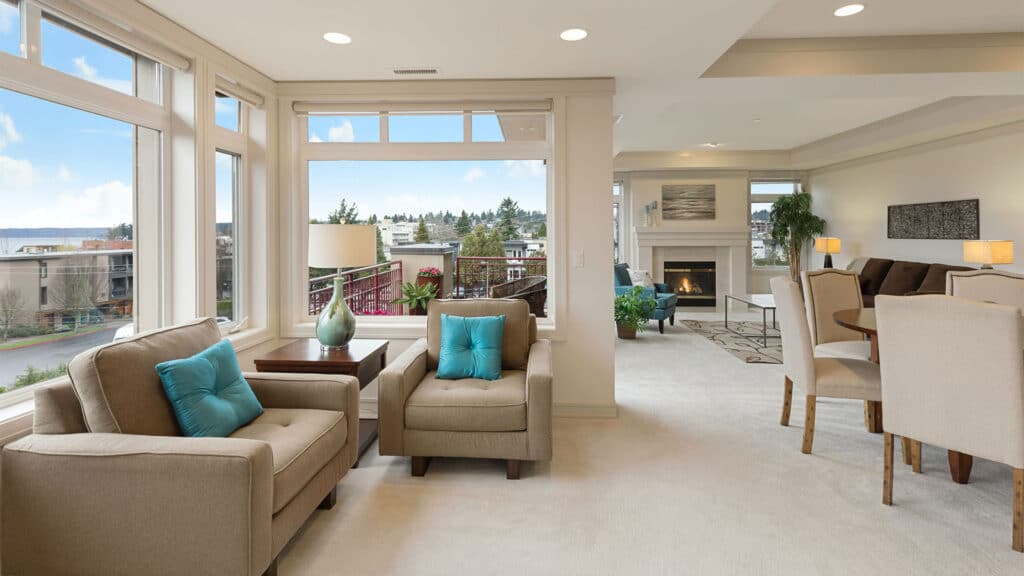
Posting a real estate listing online and waiting for the phone to ring isn’t enough in today’s residential market. Whether you’re in the crucial pre-marketing phase of selling a home, or you’re going through the frustrating first few weeks of silence after listing your property, you know exactly what we’re talking about.
Today, strategies for selling a home must be targeted, pragmatic, and focused on a very specific goal: maximizing the sale price and minimizing the time the property spends on the market. And to do that, an online listing with a few hastily taken photos isn’t enough. Just consider that potential buyers form an opinion about the property within the first 90 seconds of a physical visit—or even sooner, while viewing the photos online so it’s essential to make a strong impression right from the start.
In all of this, home staging is a valuable strategic tool for protecting the true value of your real estate assets and avoiding significant discounts during negotiations.
What Is Home Staging (and Why It’s Not Just Decorating)
Before we begin, it’s important to emphasize that home staging is not simply interior decoration, nor is it a form of traditional interior design, but rather a genuine marketing strategy applied to real estate sales, with very concrete and measurable objectives.
In practice, it involves strategically staging and preparing a property to highlight its structural strengths, visually minimize its flaws, and allow visitors to immediately recognize its living potential, without distractions.
Unlike traditional interior design, which personalizes a home based on the specific tastes of its residents, home staging does exactly the opposite: it depersonalizes the space to make it appealing to as many potential buyers as possible, regardless of their personal tastes.
The specific goal of home staging is threefold:
- Make the property feel like a home that’s ready to move into right away, helping potential buyers picture themselves living there and envisioning their life in that home
- Protecting a home’s value from the depreciation that occurs when a property remains on the market for a long time
- Significantly speed up the time it takes to close a sale, reducing it from months to weeks.
The Invisible Depreciation: How Much Does It Really Cost Not to Prepare Your Home?
Many homeowners are skeptical about the initial outlay required for a renovation and enhancement project such as home staging.
But this perspective is based on the wrong question: “How much does home staging cost?” In reality, the right question to ask in these cases is: How much does it cost to leave a home unsold on the market for months, while its value steadily and progressively declines?
A property that remains unsold on the market, without strategic preparation, suffers what we call “invisible depreciation.” This is not an official reduction in the property’s assessed value, but a real loss of commercial appeal: the more time that passes, the more potential buyers begin to suspect that the home has hidden defects or problems that aren’t immediately apparent, leading them to feel justified in making offers significantly below the asking price.
In this regard, industry data speaks for itself. According to aggregated data from 2025 by the European Association of Home Staging Professionals (EAHSP), homes that are not enhanced or staged before being put on the market experience an average drop of 7.8% from the initial listing price during the negotiation phase. For a home valued at 300,000 euros, this translates to a total loss of approximately 23,400 euros directly from the final sale price.
In contrast, professional staging reduces the average time on the market to just 40 days, compared to an average of 120+ days for homes that have not been staged. This shorter time on the market also results in less overall depreciation, because the property is sold while it still retains a strong perception of freshness and market appeal.
All things considered, the initial investment in home staging therefore costs infinitely less than it would to keep an empty home that gradually loses value, or than a hasty decision to completely renovate before selling without any guarantee of recouping the investment.
Here is a summary table showing the key parameters:
| Parameter | Without Home Staging | With Home Staging |
| Average Time to Sale | Often more than 120 days | About 40 days |
| Average discount under negotiation | A 7.8% discount off the list price | Minimized or nonexistent |
| Buyer Perception | “He might have some side jobs” | “Ready to move in, wow factor” |
| Online Photographic Impact | Low (few clicks on ads) | Very high (maximum visibility) |
| Overall ROI | Negative (depreciation + lost time) | Positive (price maintained + speed) |
Who pays for the setup?
This is the most common question on the mind of every homeowner who is about to sell: Who covers the cost of the setup? Is it included in the agency’s commission, or is it an extra charge?
The answer is that there is no single, standardized rule in the Italian real estate market. The landscape is very diverse.
Some real estate agencies include basic home staging as part of their sales management services, considering it an essential part of their sales strategy to facilitate the sale. Other agencies, however, view home staging as a specialized, additional service that must be agreed upon in advance and paid for separately before signing the sales agreement.
At Idee & Immobili, we firmly believe in absolute transparency and open communication. We discuss openly and in advance with our clients what the best solutions are for their specific property, taking into account the home’s value, its current condition, and the target market.
Virtual Home Staging: How Artificial Intelligence Will Speed Up Sales in 2026
One of the most significant innovations in the real estate sector over the past three years has been virtual home staging, that is, the digital staging of spaces using artificial intelligence technologies.
What happens if the property you need to sell is completely empty or requires extensive renovation? Traditionally, you had to rent physical furniture, coordinate installation schedules, and manage logistics costs. It was a costly and complex process.
Today, virtual staging uses artificial intelligence to create photorealistic, three-dimensional renderings of spaces. In just a few seconds, a completely empty room is transformed on screen into a contemporary designer living room, an inviting kitchen, or an elegant master bedroom.
This technology allows you to reduce physical staging costs by up to 90% compared to traditional methods, immediately showing the hidden potential of the home directly in online real estate listings, where it is most important to capture attention in a few seconds.
The compound advantage is twofold: it drastically reduces initial costs and simultaneously significantly increases the online visibility of listings, as rendering images attract more clicks than any photo of an empty or semi-dilapidated space.
Three practical steps to enhance rooms on your own
If your property is already in good general condition and you wish to prepare it for viewings without resorting to specialized services, here are three practical macro-actions you can perform completely on your own, with minimum investment and maximum impact on buyer perception.
Step one: Total decluttering
Radically lighten the spaces. Remove excess furniture crowding the rooms, empty kitchen shelves, and clear all surfaces in bathrooms, hallways, and bedrooms.
The psychological goal is to maximize the perception of available space. Buyers must feel free to imagine how to use the home according to their needs, not feel oppressed by a congested atmosphere. A space that looks larger is a space that looks more valuable.
Step two: Conscious depersonalization
Systematically remove all family photographs, personal paintings, private collections, and intimate memories. The buyer must be able to imagine their own life in that home; they must not feel like an intruder in your private life.
When entering a home full of others’ memories (photos of weddings, children, holidays, loved ones), the buyer cannot mentally visualize themselves living in that space. Your personal memory becomes a psychological barrier between them and the potential purchase. By removing it, you eliminate this barrier.
Step three: Professional light management
Brightness sells. Open all curtains and drapes, clean window panes thoroughly to eliminate dust and limescale that reduce natural light penetration, and replace all burnt-out bulbs with a color temperature that is too cold. Prefer warm-temperature bulbs that create a welcoming atmosphere.
If necessary, add supplementary light sources to further enhance natural brightness during afternoon hours.
Additional considerations for the atmosphere
The choice of materials for visual enhancement (light fabrics for cushions or throws on sofas, fresh flowers in vases, neutral-toned rugs) contributes to creating an atmosphere perceived as premium and well-kept. Remember, however, that for heavier structural interventions, such as knocking down walls, redistributing internal spaces, or significant changes to the square footage, the crucial role of the architect in overall enhancement comes into play.
A fundamental warning before proceeding
Aesthetic beauty and visual enhancement are useless (and counterproductive) if the property has building violations, cadastral discrepancies, or legal urban compliance issues. Before investing time and energy in visual rendering, ensure you have the correct legal status of the property to close the sale safely at the notary and without legal surprises in the final stage of the sale.
How we apply property enhancement in Tuscany
La nostra esperienza pluriennale sul territorio toscano ci ha insegnato una lezione fondamentale: ogni mercato locale ha le sue regole, le sue dinamiche specifiche e il suo target di acquirenti con esigenze e aspettative diverse.
Consequently, property enhancement is not a standardized process. It must necessarily adapt to the territorial context and the composition of the local market.
Florence: enhancing period volumes in historic centers
In the Tuscan capital, the strategic focus of enhancement is on split apartments in historic buildings or property units located in protected historic centers. Home staging in Florence serves to highlight prestigious architectural elements such as original exposed beams, particularly high ceilings, Tuscan terracotta floors, or loggias with city views.
The target is often represented by families residing in Tuscany looking for a second home with authentic charm, or by foreign investors (from the USA, UK, France) looking for an authentic “Tuscan home.” For these buyers, historical features are an asset, not a burden.
Prato: maximizing the perception of space in residential properties
In Prato, the real estate market target is mainly composed of modern families looking for an “extra room” and commuters who work in Florence or other provincial capitals and seek a quality housing solution with short travel times.
Here, strategic staging and home staging focus on visually demonstrating the livability of the large square footage available (independent houses or generous two/three-room apartments), on the pragmatic functionality of gardens, terraces, or outdoor spaces, and on the ease of reaching services (schools, shopping centers, hospitals).
Sesto Fiorentino: optimizing classic layouts for the dynamic market
In Sesto Fiorentino, the market is extremely lively and dynamic, where over 60% of buyers are under 35, young professionals, young couples, and startup founders. In this demographic context, home staging aims to optimize the city’s classic layouts (functional two-room apartments, smart studios, very small three-room apartments) by visually transforming them into dynamic, modern, and versatile spaces.
Territorial positioning is crucial: every property is presented emphasizing its proximity to hospital hubs (Careggi, Meyer), university scientific districts, and technological innovation zones. For this young and tech-savvy target, photographic quality and digital presentation are also fundamental.
Frequently asked questions about preparing your home for sale
How much does a home staging service cost?
In Italy, costs vary significantly based on the size of the house, its current state, and the level of intervention required. A light consultation of analysis and advice for properties already reasonably furnished starts from a few hundred euros. A complete physical staging intervention for completely empty properties, with furniture rental and total setup, typically ranges between 1,500 and 2,500 euros according to EAHSP 2025 data. For particularly prestigious properties or very large square footages, costs can naturally be higher.
What are the most common mistakes to avoid when selling a home?
The most frequent mistake is leaving personal family photographs in plain sight during viewings. Buyers cannot visualize themselves living in a home full of others’ memories and faces: it is a psychological barrier that reduces attractiveness. Equally important is not neglecting small maintenance defects (burnt-out bulbs, stains on walls, dirty fixtures): these details immediately destroy a positive first impression and lead buyers to think there are hidden structural problems.
What are the most effective tricks for selling a home quickly?
The secret emerging from all industry data is the combination of maximized natural light and deep decluttering. Completely clear every flat surface in the kitchen (no small appliances or objects) and in the bathrooms (minimum visible essentials). A fresh coat of paint in neutral tones (white, beige, light gray) radically transforms the perceived atmosphere of the home, making it more modern and bright. Furthermore, relying on innovative real estate networks or structured and specialized agencies significantly accelerates commercial processes.
Who pays for the cost of home staging in a real estate agency?
As explained previously, there is no single standard. Some agencies include basic staging in their sales management services, considering it part of the global commercial strategy. Other agencies consider it an additional specialized service to be agreed upon in advance and funded separately. Idee & Immobili always offers personalized and transparent solutions, discussed openly with the owner, to optimize the investment and protect the value of the real estate capital.
Start preparing your home today
The strategic preparation of a home for sale is not an additional expense: it is a concrete financial investment in the value of your real estate assets.
If you have doubts about the methodology, if you are still gathering information on the compatibility of structural interventions with urban compliance, or if you need to organize the bureaucracy of documentation before viewings, we invite you to consult our complete guide to the documents needed to sell a home.
Idee & Immobili is at your disposal to guide you through this crucial phase of property enhancement. Because selling a home is an important decision that deserves to be approached with peace of mind, complete information, and proven strategies.